COMMUNITY FAIR – ROBOTS, SPACE, SMALL THINGS
Interactive Stands
Spark young imaginations with hands-on science and engineering fun for all ages at the Nancy Rothwell Building. Whether you’re curious about the earth, space or virtual worlds, there’s something here for everyone.
Interactive stands you can visit in the Nancy Rothwell Building:
Explore the Universe with Jodrell Bank
Join the Jodrell Bank engagement team and share the wonder of space. Make your own iconic Lovell Telescope hat, explore the hidden world around us, and guide robots on a journey through space while learning about the next generation of radio telescopes.
Lego rovers
Try your hand at coding a Lego Rover to discover how we communicate with robots on distant planets like Mars and navigate new worlds aboard the futuristic explorer rover.
Robot dog
Meet robot dog – they can walk, jump and sit. Find out how robots like this can sniff out danger in hazardous environments.
Virtual reality
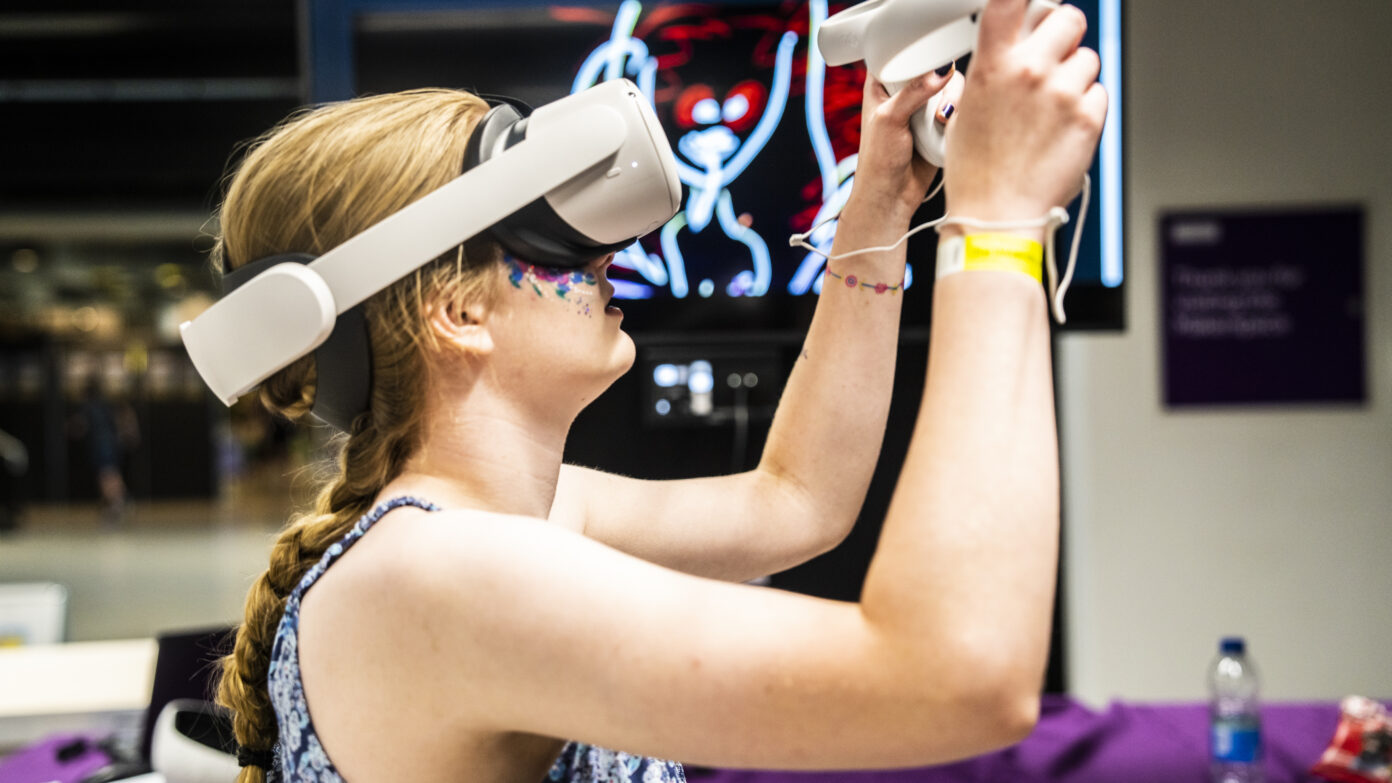
Immerse yourself in new worlds and interact with amazing avatars, medical simulation journeys through the human body, go swimming with dolphins or take the challenge to walk the plank! (This activity is for the over 10’s)
Adventures with volcanoes
Find out what magma looks like deep underground – how does it change and move and what happens when it reaches the surface? See how we track volcanic gasses around the globe. Test your nerve with our volcano eruption!
Light labs
Discover how we use light in research – create your own striking Prussian blue images with cyanotype printing using light alone and challenge yourself in a laser maze game where you bounce and twist light around the board.
Maths and maps
Why do shapes, sizes and perspectives change when we turn the spherical Earth into a flat map? Discover how maps are made and how maths is used to create different map projections.
Blackout the jargon: science poetry
Although scientists publish their work in academic journals these can often be difficult to understand because of the language used. Join us for blackout poetry, where you can find meaning in a scientific text by selecting certain words and redacting the rest to create a literary and visual work of art.
Physics for babies and toddlers
Step into a world where the tiniest explorers discover the biggest secrets of the universe. This sensory experience transforms particle physics into a playground of colour and touch for the youngest of visitors and their grown-ups.
Graphene wonders
What happens when you explore materials that are unimaginably small? Discover the wonder material – the one atom thick graphene, find out about future applications and how it is already being used in our everyday lives.
Micromaps and microstructures
Use a microscope to view tiny maps of Greater Manchester and semiconductor structures patterned on silicon wafers which can be used in microchips in modern electronics.
Seeing the unseen: a particle physics mystery
How do scientists explore things they can’t see? Just like real physicists, you’ll use particles to reveal the invisible! What will you discover?
Tinker Time: build it, move it!
Tinkering is all about experimenting and learning how things work. So put your creative skills into action to build and decorate your own windmill.
Eco-Design: smart and sustainable living
Explore how everyday choices impact the planet. Design an eco-friendly home or get creative formulating your own environmentally conscious body wash.
Cup-to-medal
Make and decorate your own top prize medal from a polystyrene cup.
Mapping material science and engineering
Can water behave differently on different surfaces and how does it follow paths and patterns to reveal hidden tracks?
Radiation detectives: Can you trust your senses?
Radioactivity is all around us but how can you tell? Test your senses in a weight challenge – using just sight or touch, can you work out which doll is the heaviest? Then use a detector to find out which objects give off radiation.
How to mend a broken heart
Discover how natures building blocks of amino acids and sugars can make jelly-like materials to repair or restore damaged parts of the body such as the heart, liver, tendons, or bone.
Watching chemistry in action
Explore how cooking, ageing, and decay create tiny particles called radicals, and how scientists use equipment to study them in ancient mummies and everyday materials like toast!
SuCCEED – biofuels and enzymes
Find out how we use natural enzymes to produce plastics and fuel through colour-changing reactions and fruit experiments.
How do you detect an invisible gas?
Hydrogen gas is used in many commercial applications, but it is a colourless, odourless, and highly volatile gas, so using sensors to measure for safety and efficiency is vital. See our live hydrogen sensor demo in action as we show we can detect invisible this invisible gas.
Find the Nancy Rothwell Building on our interactive campus map and check out our accessibility information guide.